

When Kevin Holmes talks about diesel technology, he is really talking about opportunity.
Holmes, founder of Advantage Truck Group (ATG), began his business in 1984 with a service station in Ashland, Massachusetts, a gas pumper and $12,000 in life savings.
More than four decades later, ATG has grown into a three-state operation with eight locations selling and servicing big highway rigs, but Holmes has never lost sight of the people who will carry the industry forward. That’s a big reason why ATG has become such a strong supporter of SkillsUSA Massachusetts - including hosting the state diesel technician state competition for the sixth year this spring.
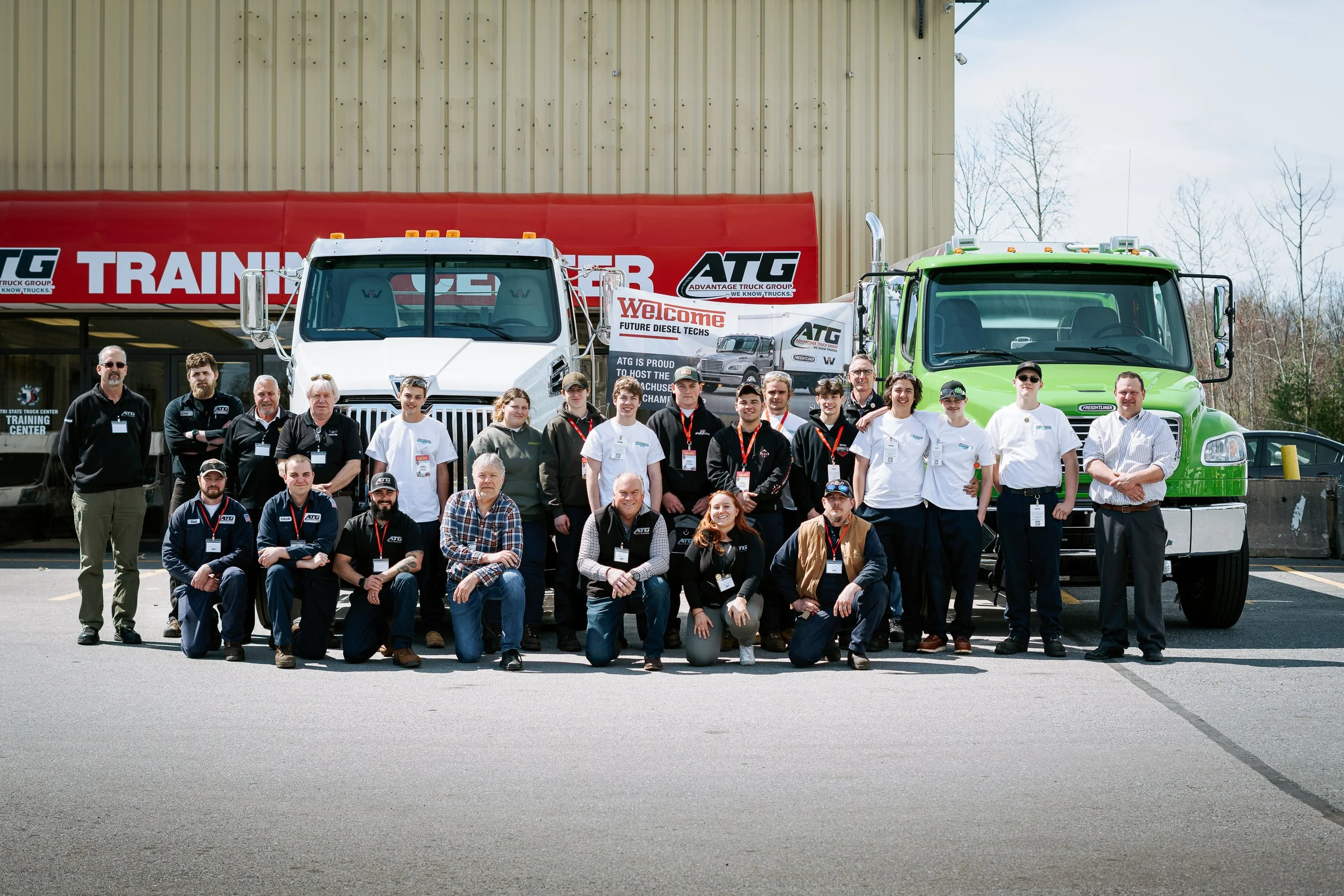
Students competing in diesel technology at the state level do so in ATG’s state-of-the-art setting in Shrewsbury, where they rotate through 10 stations while working alongside the company’s technicians, managers and leaders who volunteer their time to support the event.
“They are walking into the future of their lives,” Holmes said.
More than one path to success
That future, Holmes stressed, is not limited to one job title. He initially sees SkillsUSA students as future technicians, but he sees even further down the road into their careers.
“They’re in this competition, because they are the best of the best,” Holmes said. “That’s why we want them in our business. We want future leaders. We want people we can develop, not just as technicians. We want service writers. We want service managers. We want service directors. These are career paths that can literally lead to, quite frankly, where I’m sitting today – to ownership.”
Brittany Donovan, ATG’s director of marketing, said SkillsUSA students often stand out because they arrive with both technical ambition and a drive to keep learning.
“Skills does a wonderful job of taking those students that have that desire, that appetite, that aptitude for leadership and development beyond the classroom,” she said. “They are so much more engaged in terms of learning as soon as they actually come into the doors. They’re used to taking on additional training. That is something that’s an expectation of those students.”
Training for a changing industry
That mindset is especially important in an industry that has changed dramatically. Holmes, who described himself as once being “self taught as a diesel mechanic,” said today’s diesel technician works in a world of advanced safety systems, diagnostics and emissions technology that would have been unimaginable when he started out.
“Today, you’re a diesel technician because of the technology and the complexity of the vehicles,” he said.
Behind every delivery, supply chain and essential service is a truck. In fact, roughly 72% of all freight in the United States is moved by trucks, according to industry estimates – a figure that underscores just how critical diesel transportation is to the economy. From food and medicine to construction materials and consumer goods, nearly every sector depends on a steady, reliable trucking network to function.
That reality makes the need for skilled diesel technicians even more urgent. As vehicles become more advanced and demand for freight continues to grow, the industry depends on a new generation of trained professionals to keep those trucks – and the economy – moving safely and efficiently.
That evolution is one reason Holmes pushes back on outdated assumptions about trade careers. They are highly skilled, highly technical professions that come with strong wages, advancement and stability – without the debt burden many college graduates face.
“I have technicians that are six-figure-plus earners,” Holmes said. “This is what people don’t see.”
He believes SkillsUSA helps students and families understand that reality earlier and more clearly. At a time when more young people are reconsidering the traditional four-year college path, Holmes sees career and technical education as an increasingly powerful option.
“Parents need to allow their children to choose their career path, not choose it for them,” he said. “For years, parents just said, ‘You have to go to college, you have to go to college, you have to go to college.’”
Industry support makes the difference
For Holmes, another strength of SkillsUSA Massachusetts is how closely it connects education and industry. He credits Executive Director Karen Ward with building those relationships and keeping the organization aligned with real workforce needs.
“She has the industry leaders supporting SkillsUSA Massachusetts,” Holmes said. “Those are the same leaders that are saying to the vocational schools, ‘Listen, you need that new tool set? You need that tooling? Here you go.’”
ATG’s support also extends beyond competition day. The company works with vocational schools, donates trucks and equipment and invests in training that helps students build real-world experience. Holmes said the company currently has 18 graduates of vocational technical schools working full time across the business, with 11 more in the pipeline.
For both Holmes and Donovan, the partnership with SkillsUSA Massachusetts is also about character.
Through ATG’s Hauling for Hunger initiative, employees and SkillsUSA students alike participate in service efforts that support families and organizations in need. Holmes said the company expects to surpass 100,000 meals served this year, and SkillsUSA staff members and students have become part of that work.
“SkillsUSA is not just about technology and students,” Holmes said. “SkillsUSA is about the community and giving back as we do.”
Donovan said that commitment is part of what makes SkillsUSA students distinctive.
“They are consummate professionals,” she said. “They understand the proper workforce etiquette, but then they also are servants of the community. SkillsUSA connects students to their communities, and that’s long lasting.”