

Superintendent takes ‘all-in’ approach to SkillsUSA and career education
“I said, if I ever taught anywhere,
it would be here,”
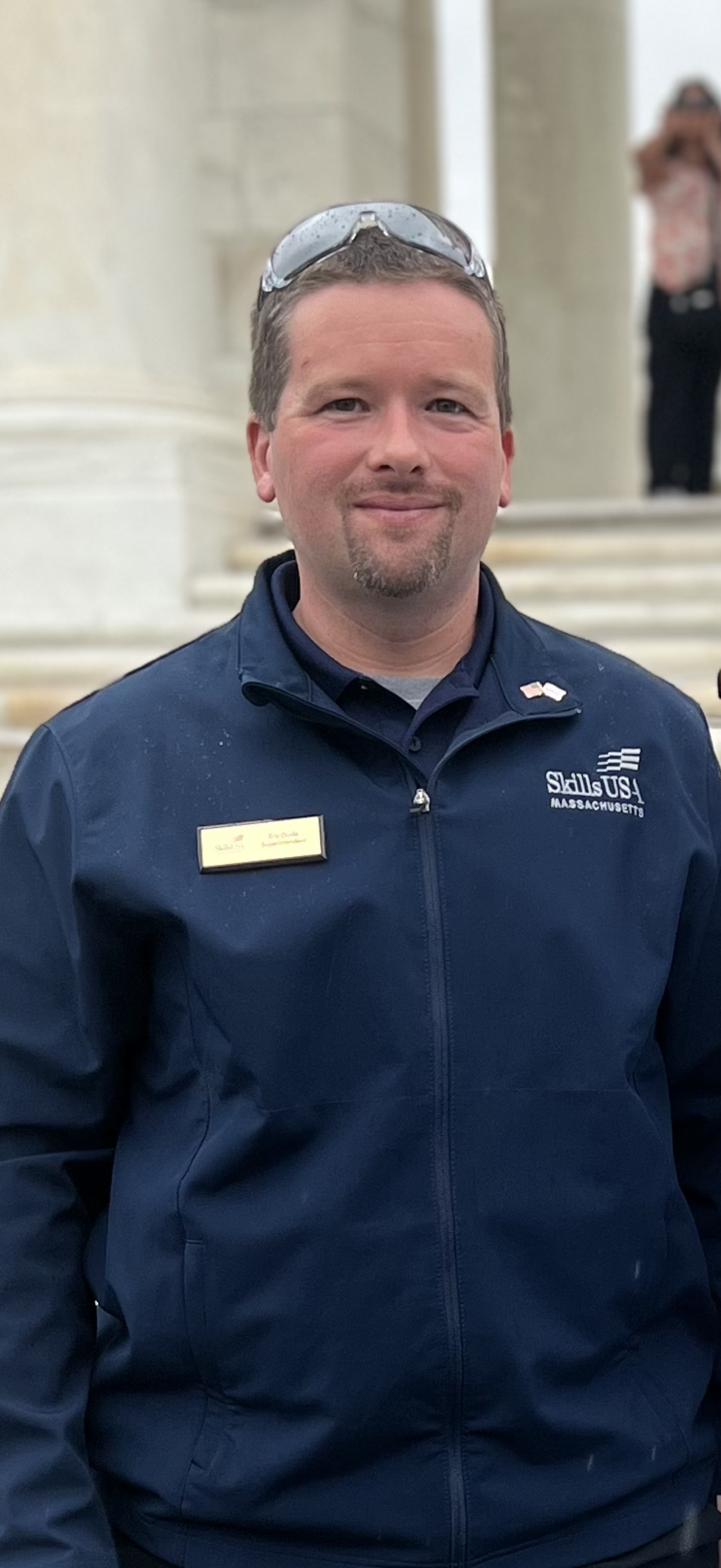
When Eric Duda talks about career and technical education, it’s not theoretical. It’s personal.
He sits at the helm of Pathfinder Regional Vocational Technical High School District as superintendent – but long before that, he walked its halls as a student. His parents did, too, part of the school’s very first class when it opened in 1973. Today, two decades into his career at Pathfinder Tech, Duda is leading a transformation rooted in both legacy and urgency – one that positions students not just for jobs, but for impact.
That sense of purpose is evident in everything from Pathfinder’s rapid growth to its full embrace of SkillsUSA. And Duda’s journey reflects the very pathways he now champions.
A graduate of Pathfinder Tech’s electrical program, he went on to study electrical engineering and gained hands-on experience in the field. But a chance encounter – literally at a tire shop – changed his trajectory. A former superintendent encouraged him to return and teach.
“I said, if I ever taught anywhere, it would be here,” Duda said.
And within weeks, he was back, this time as an electronics and robotics instructor. Over the years, he moved through the ranks: teacher, vocational director, cooperative education coordinator, principal, assistant superintendent and now superintendent, a role he has held for five years.
Each step reinforced a core belief that education should lead somewhere tangible.
A school growing while others shrink
Pathfinder Tech serves about 650 students across nine rural towns in western Massachusetts, an area where many school districts are facing declining enrollments. Pathfinder Tech is seeing the opposite. “We’re one of the only districts around that’s expanding,” Duda said.
Over the next three years, the school will add 150 seats – about a 25% increase – by repurposing a nearby elementary school that’s closing. With expansion comes new programs, likely in medical assisting, engineering technology, early childhood education, public safety and veterinary science.
“We have more students who want this model than we have seats,” Duda said. “If a student wants to be an electrician or a nurse, we should have a place for them.”
Indeed, Pathfinder Tech’s growth signals a broader shift, as students and families are increasingly seeking direct pathways to careers.
Going ‘all in’ on SkillsUSA
One of Duda’s most defining moves came early in his administrative career by making Pathfinder Tech a 100% SkillsUSA school when he became vocational director. Today, every Pathfinder Tech student has access to SkillsUSA opportunities, from leadership development to technical competitions at the district, state and national levels.
When Duda was a student, participation was limited to a few programs. Now, the organization is embedded in the school’s culture.
“I believe in competition,” he said. “Let’s recognize excellence. Let’s challenge students. That’s how they grow.”
The results speak for themselves. Pathfinder Tech students regularly earn spots in the state competition, with multiple advancing to the national level each year. For a school of its size, that’s a point of pride – and proof of concept.
Changing perceptions and futures
During his Pathfinder Tech tenure, Duda has witnessed a major cultural shift in how people view career and technical education. “When I started, there was still that mindset that if you couldn’t go to college, you did this instead,” he says. “That’s completely changed.”
Today, parents are asking a different question: Will my child have a good job and a good life?
Pathfinder Tech and programs like SkillsUSA offer a clear answer. Students graduate with real skills, industry experience and often certifications that allow them to enter the workforce immediately or continue their education with a strong foundation. Many go on to high-demand fields in construction, health care, public safety and advanced manufacturing.
“These aren’t low-wage jobs,” Duda added. “They’re careers. You can build a business. You can build a life.”
A national imperative
For Duda, the importance of career education extends beyond individual success. He sees it as a national priority. “We’re part of the solution,” he said.
He points to the growing skills gap across industries – from construction to infrastructure to emerging technologies – and warns of the long-term consequences if it’s not addressed.
“Who’s building the data centers? Who’s doing the electrical work, the plumbing, the engineering?” he asks. “If we don’t have skilled workers, we have a problem.”
In fact, Duda goes a step further, calling the shortage of skilled labor a potential national security issue. “If we can’t design, build and maintain our own infrastructure and technologies, that’s a risk,” he said. It’s a bold statement that’s grounded in the realities he sees every day.
The power of possibility
Despite the challenges, Duda remains deeply optimistic, and much of that optimism comes from watching students in action. Attend a SkillsUSA event, he said, and you’ll see it immediately.
“The energy, the pride, the possibility – it’s all there,” he said. “It makes you feel good about the future of this country.”
That sense of possibility is what drives him to keep expanding programs, investing in opportunities and advocating for SkillsUSA at every level.
“I’m all in,” he added. “We’re going to keep growing it, keep improving it and keep giving students every opportunity we can.”